



Regulatory Turbulence: Beer Faces Restrictions and Excise Taxes in 2025
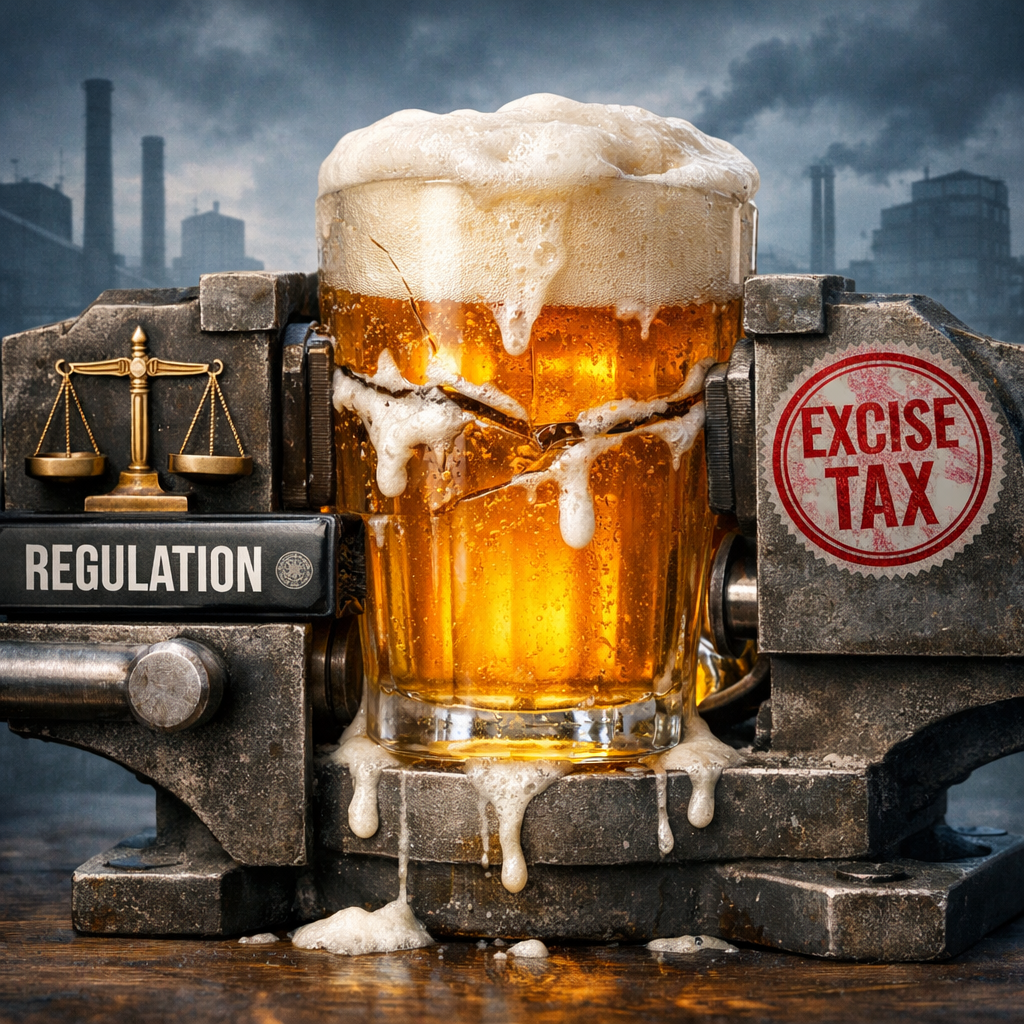
The Russian beer market is closing the year in regulatory turbulence: regions are increasing restrictions, turnover control requirements are becoming tougher, and an increase in the tax burden and a new regulatory framework are on the horizon. 2025 was actually a transitional year, when businesses had to simultaneously hold back sales, reconfigure processes, and prepare for 2026-2027, where changes affect the entire chain — from production to shelf and inspection.
The key case of the year is the Vologda Oblast. From March 1, the sales window is 12:00-14:00 on weekdays in stores, 08:00-23:00 on weekends and on a number of holidays; at the same time, the requirements for the placement and format of points, including residential buildings, were tightened, and point exceptions were introduced for December 30-31, January 7 and May 1, in order to reduce social tension. The regional authorities declare a decrease in “rapid” negative effects and show structural shifts in retail: according to their data, the number of alcohol markets has decreased from 610 to 140, 67 out of 125 “filling stations” have closed.; A separate marker is the suspension of the license of Krasnoe&Beloe due to sales to minors, where the court supported the regulator’s position. At the same time, the final effect remains a matter of dispute: “consumption” statistics record an increase in November to 9.84 liters per person against the background of a nationwide decline, while the region refers to the USAIS and speaks of -1.24 liters per person and -18.2% of sales in January–November, and the expansion of shadow channels and purchases are discussed in the public field. “for future reference.”
The signal for the industry is that other regions are beginning to try on the Vologda scenario: the Ministry of Health calls it “best practice,” but RATK warns of the risk of demand flowing into the illegal segment and the growing share of surrogates. New strict rules have already been announced in the Altai Republic from March 1, 2026, and in a number of subjects restrictions become the subject of legal disputes and proceedings with the Federal Antimonopoly Service. At the same time, the market is entering the federal cycle of changes “in numbers”: from 2026, the excise tax on beer with a strength of up to 8.6% will increase from 30 to 33 rubles/l (further 34 rubles/l in 2027 and 35 rubles/l in 2028), and for beer with a strength of 8.6% — from 56 to 62 rubles/l.liters (followed by 64 and 67 rubles/liter, respectively), which increases the pressure on the cost and retail price of a liter. At the same time, the economics of licenses are changing — instead of a conditionally “network” approach, the load is becoming piecemeal: a fee is charged for each outlet (65 thousand rubles per year per facility, 20 thousand rubles — for rural settlements), increasing fixed costs and raising the minimum “payback threshold” for each location — especially for networks with a wide geography and a large number of small formats. In conjunction with the new GOST for beer (effective January 1, 2027, with the right to early application), which narrows the scope in terms of product parameters and classification and carries risks for some strong and niche positions, 2026 becomes the year when those who have recalculated the unit economy in advance and rebuilt the assortment/logistics/ wincompliance for the new “cost of a liter” and “cost of a point”, and not those who enter the cycle without margin safety margin.