


Global beer market: stagnation of beer sales and sustainability of the raw materials segment
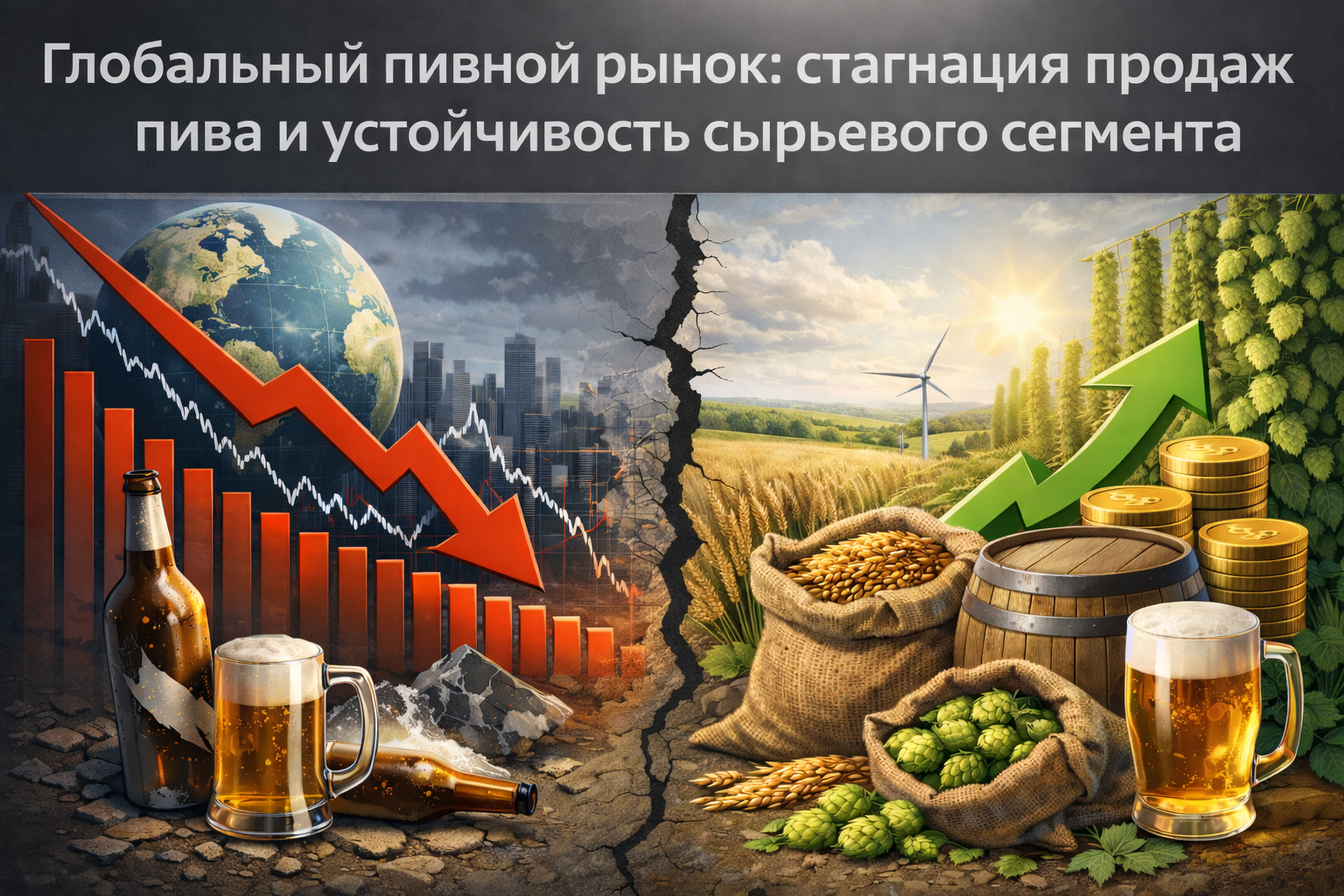
By the beginning of 2026, the global brewing industry continues to be in a phase of protracted stagnation. The year 2025 confirmed a decline in beer consumption for the third year in a row amid rising prices, pressure on real incomes and changes in consumer preferences. Some of the demand is shifting towards non-alcoholic and low-alcohol beverages, but this segment has not yet compensated for the decline in classic beer categories. As a result, the beer market has to adapt not only to economic constraints, but also to a structural shift in consumer behavior.
Manufacturers are responding to these challenges by optimizing and changing their development strategy. In developed markets, the focus is shifting from volume to marginality and product value: the share of niche, seasonal and non-alcoholic varieties is growing, and the role of marketing and branding is increasing. At the same time, the industry is going through a stage of reducing excess capacity — in Europe, shutdowns and conservation of malt houses and breweries are being recorded. For example, in 2025, the Soufflet Malt group (InVivo) announced the phasing out of production at the last two Durst Malz malteries in Germany: the Heidelsheim site will be shut down by the end of December 2025, and the Gernsheim plant in the first quarter of 2026.
Thus, the beer market is gradually shifting from extensive growth to a more compact and diversified model.
The decline in global beer production has directly affected the raw material supply chain. Demand for malt and malting barley remains subdued, and the premium of malting barley to feed barley has been at its lowest levels in recent years, despite high quality and record harvests. The paradox of the current phase is that the physical supply of raw materials is excessive, while processing is limited by weak demand for the final product.
The Russian market as a whole follows a global trajectory, but with its own specifics. Malt production for 11 months of 2025 amounted to 1,455 thousand tons, which is 0.4% lower than the level of the same period in 2024 (1,461 thousand tons). The output of beer and beer drinks decreased to 856.6 million dal, which corresponds to a decrease of 1.3% YoY. A significant factor in the pressure on consumption in Russia was the increase in excise taxes, which accelerated the growth of retail prices and increased demand restraint.
At the same time, despite the decrease in beer consumption, prices for malted barley do not show a drop, and the situation on the malt market remains relatively stable. This indicates that the balance in the raw materials segment is maintained due to contract purchases, limited imports and support from export channels. Thus, the negative background of the beer market in Russia has not yet translated into a crisis in the commodity market.
In the short and medium term, the beer and malt market in the Russian Federation will be in an adaptation mode. The growing fiscal burden will continue to put pressure on consumption, but the stability of the malt segment and prices for malted barley creates the basis for maintaining production stability. Under these conditions, the key factor is not the recovery of volumes, but the flexibility of the barley–malt–beer chain and the industry’s ability to operate in conditions of structurally lower demand.